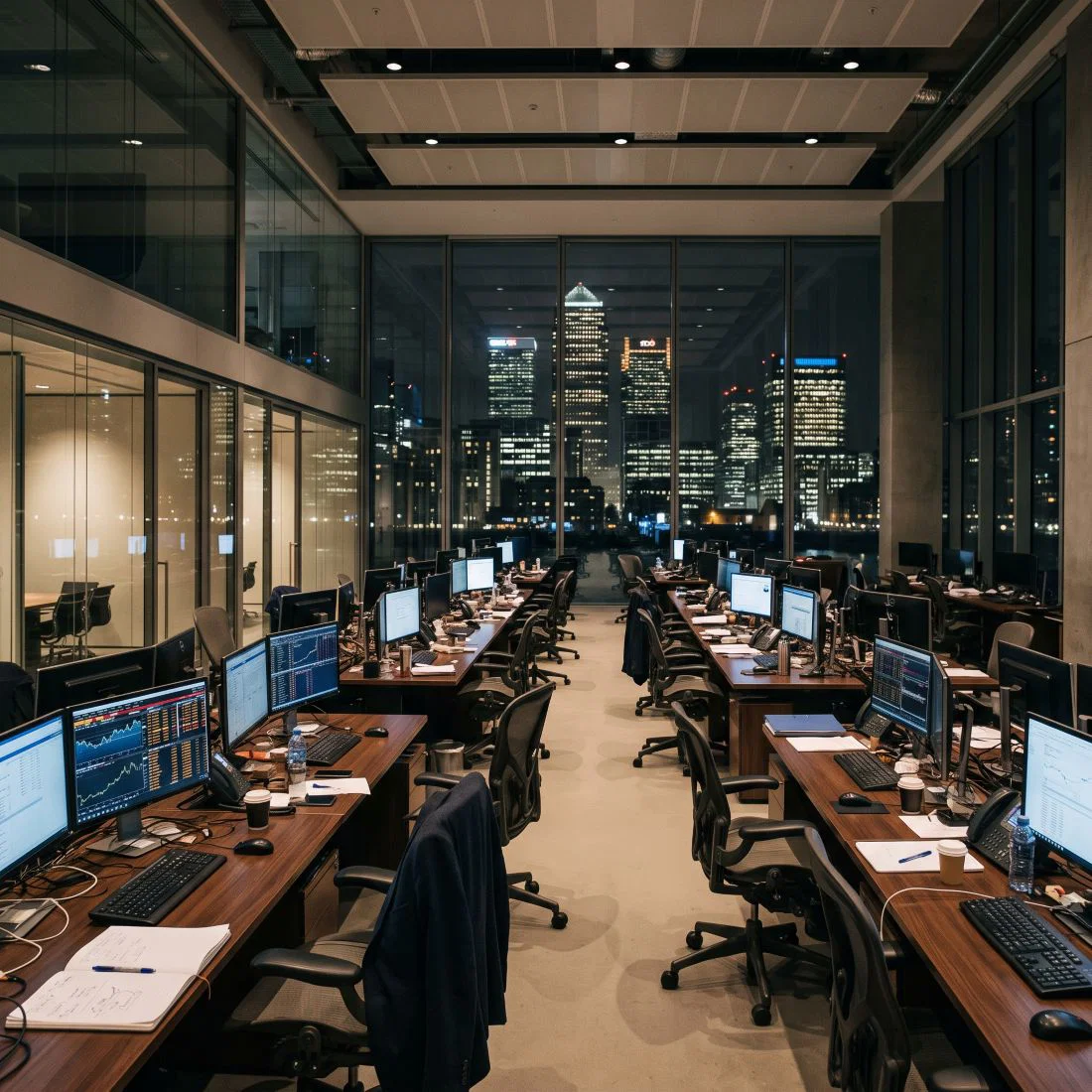
Why Trading Floors in Canary Wharf Never Get a Night Shift, and What That Does to Carpet Maintenance
There is no night on a trading floor. That’s the whole problem, and every awkward thing about maintaining the carpet in one follows from it.
Every other commercial floor I work on in London has a dead period. Offices empty at seven, shops shut at nine, theatres go dark on a Monday. A dealing room in Canary Wharf has no equivalent. Wellington and Sydney open on Sunday evening UK time, Tokyo follows, London picks it up, New York carries it to ten at night, and by the time the last US desk logs off the Asia coverage team in the same building is already back at their screens. The floor is occupied at four in the morning. It’s occupied at four in the morning on a Tuesday in August.
Why is there no window?
Because the clock the desks run on has no gap in it. The one genuine pause in the trading week runs from the US close on Friday evening to the Asia-Pacific open on Sunday evening, and that pause is spoken for before anybody thinks about carpet.
Weekends on a bank floor belong to technology. Change windows, patching, disaster recovery failover tests, network cutovers, hardware refreshes on the dealer boards. All of it is scheduled months ahead through a change advisory board, and all of it requires the floor to be quiet, controlled and free of people who aren’t on the change ticket. A cleaning contractor with a machine is not on the change ticket.
What’s left, in a typical year, is a handful of Saturdays and the days when the major markets are closed simultaneously. That’s a small number of hours to maintain forty thousand square feet of heavily used floor covering.
Access eats into what remains. Dealing rooms sit behind their own card layer inside a building that already has one, visitors are escorted rather than badged, phones go in a locker, and the escort has to be somebody with authority to be on the floor at that hour. Two operatives can lose forty minutes at the barrier before a machine leaves the trolley.
The weekend that IT already owns
I’ve had a Saturday cancelled at eleven on the Thursday night because a DR test slipped a week. Once you understand that the change calendar outranks everything, you stop building programmes that depend on weekends and start building them around work you can do with the desks live.
What does permanent occupancy do to the carpet itself?
It inverts the normal soil pattern. In a conventional office the space under a desk is the cleanest carpet in the building. On a trading floor it’s the worst, by a distance.
Traders eat at the desk. There is no lunch hour on a floor covering a European session, so breakfast, lunch and whatever arrives at four in the afternoon all get consumed at the position, over the keyboard, above the carpet. Rice, noodles, dressing, coffee, protein shake residue, all of it landing in a square metre that a vacuum head can barely reach because there’s a pedestal on one side, a CPU tower on the other and eight cable runs down the back.
Then there’s the chair. A trader occupies one position for eleven hours and the castors work a shallow arc into the pile through that whole period, grinding whatever’s been dropped into the base of the tuft. The arc goes bald and grey in a way the walkways never do. Five years of that produces a pattern of dark ellipses across the room at 1.5-metre intervals, visible from the far end of the floor and impossible to explain away as general wear. The tile is worn through to the primary backing in the middle of some of them.
The two square metres nobody can reach
Desk positions on a modern floor sit at 1.4 or 1.5 metre centres in pods of six or eight, with monitor arms, under-desk PCs and a cable tray that runs the length of the bench. Nobody moves any of it. The nightly cleaner runs a vacuum down the walkway and up to the edge of the desk line, and the carpet from the desk edge inward gets touched perhaps twice a year.
That’s where the smell comes from when a floor develops one. Not the walkways. The dropped food under position 34 that has been there since a Friday in June.
What can be done with the desks live?
More than most facilities managers expect, if the method is quiet, dry and small.
The unit of work is the pod rather than the floor. Six desks at a time, twenty minutes, using a compact battery-powered cylindrical machine and an absorbent compound or a low-moisture encapsulation product applied by hand-sprayer rather than through a tank. No hoses, no cable across a walkway, no tank on wheels blocking a fire route.
Timing follows the sessions rather than the clock. The window that works on most European-focused floors is between about half one and three in the afternoon, after the London lunchtime lull has settled and before the US open lifts activity again. A desk that’s vacated for twenty minutes is a desk you can clean. Some floors run a handover around two where the Asia coverage seats empty out entirely, and that’s four hours of usable time a week if you’re organised about it.
Chairs are the one thing worth asking to move. A trader will lift a chair out of the way for twenty seconds if you ask at the right moment and explain why, and that single concession opens up the arc, which is the area that matters most. Nobody moves a pedestal or a tower, and I stopped asking years ago.
Spot response has to be immediate rather than scheduled. A curry spill at a live desk gets worse every hour it sits under a heat-producing tower, and a floor that has a technician in the building during trading hours gets a different outcome from one that logs a ticket for Thursday.
Noise, and the recorded line
Dealer lines are recorded for compliance and the recording captures the room, not the handset. Background noise on a trading floor is a regulatory artefact rather than an irritation, which is why the noise limit on any equipment I take onto a floor is stricter than anything I’d apply in an office.
Cordless machines have changed this work completely. A quiet cylindrical brush machine running off a battery is a different proposition from a mains upright, and the difference between the two is the difference between being allowed on the floor with the desks live and being told to come back at Christmas.
What about water?
Very little, and never near a floor box.
Trading floors carry an unusual density of power and data at floor level. Floor boxes every couple of metres, cable exiting through grommets, under-desk power strips sitting directly on the carpet, and in some rooms UPS-fed circuits that must not be interrupted for any reason short of a fire. The consequence for cleaning is a hard rule: nothing wet within a metre of a box, a grommet or a power strip, and hand tools only in that zone.
Static is the other consideration. Dealing rooms often specify a static-dissipative carpet tile with a conductive yarn or backing, and the anti-static performance depends partly on the tile being free of certain residues. Some cheap encapsulation polymers leave a film that interferes with it. Anything going onto a floor like that should be checked against the tile manufacturer’s maintenance guidance rather than assumed.
The metre around a floor box
Work it by hand with a spotter and a microfibre, or with an absorbent compound brushed in and vacuumed off. That’s slower per square metre than anything else in the building and it’s the area that most needs doing, since it sits directly under the food.
What does a workable annual programme look like?
Three layers, and the biggest one isn’t cleaning at all.
Daily, a technician on site during trading hours for spot response and pod work. Two hours a day on a large floor, rotating so every pod gets attention roughly monthly. Quarterly, a Saturday if the change calendar gives you one, running restorative work across walkways and lift lobbies. Annually, the Christmas period, when the markets that matter are closed for two or three consecutive days and you can take the floor properly.
Good Friday is worth asking about. Some floors stand down almost completely; others staff for markets that stay open, in which case you get half a room. Late August bank holiday is the one people assume will work and it rarely does, because US markets trade as normal and the desks covering them are at their screens on Cabot Square while everyone else in London is at a barbecue.
Where I talk myself out of work
The third layer is tile replacement, and this is the part of the conversation that costs me revenue. On a floor with a decent stock of matching spare tile, swapping out the sixty worst chair-arc positions is faster, cheaper and produces a better visual result than restoring them. Restoration on a bald, oil-loaded chair arc gets you a clean bald patch. Keep four or five per cent of the original order sealed in the store room at fit-out, and rotate desk-position tiles with under-walkway ones every couple of years so the wear distributes.
Facilities teams resist this because tile replacement is a capital conversation and cleaning is a revenue one. That’s an accounting problem, and it costs banks a great deal of money in floors that get cleaned repeatedly when they should have been swapped.
A floor I look after off Bank Street had its whole east pod block swapped over three consecutive Christmases, forty tiles at a time, and the room still reads as one continuous installation from 2018.