How West End Theatres Get Auditorium Carpet Cleaned Between a Matinee and an Evening House
“You’ve got from twenty past five,” the house manager told me, standing in the stalls at a house off Shaftesbury Avenue with a clipboard and no interest in negotiation. “I’m opening the house at half six. There’s a band call at six on stage, so nothing with a motor after ten to. And don’t touch the treads on the left, the rope’s come off.”
That is the brief. Not a specification, not a scope of works, a set of constraints delivered in forty seconds by someone who has eleven other problems. Two-show days in the West End produce a cleaning window that looks like two hours on paper and behaves like fifty minutes, and everything about the method has to bend around that rather than the other way round.
What is the real window between the two houses?
Take a matinee coming down at 17:05. The audience takes twelve to fifteen minutes to clear, longer if there’s a stage door crowd or a wheelchair party in the stalls needing lift access. Ushers do their sweep for lost property and left bags. You’re on the carpet at 17:25 at the earliest.
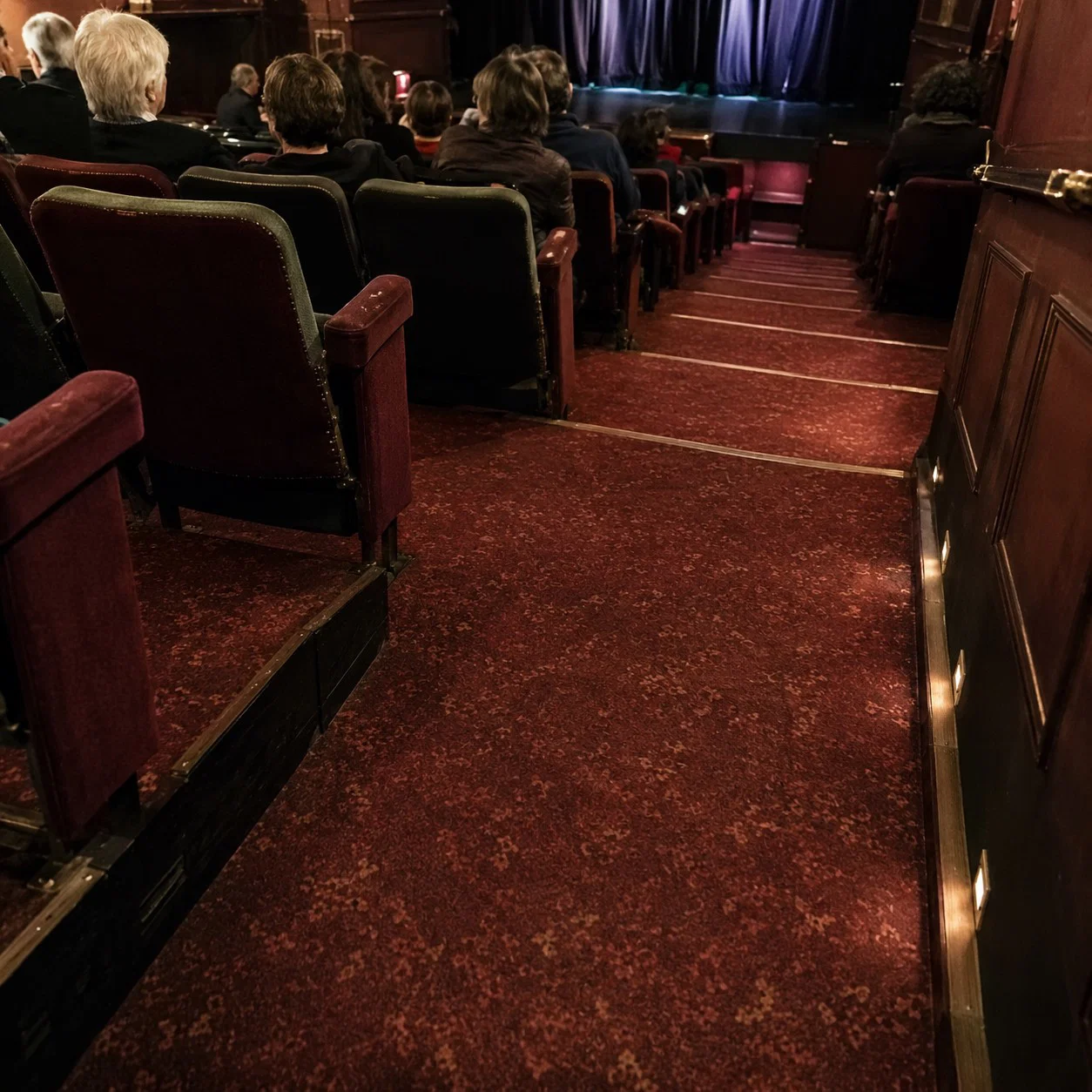
The house opens thirty minutes before curtain-up as standard, so a 19:30 show means front of house wants the auditorium presentable by 19:00. Deduct ten minutes at the end for grooming, moving kit out and getting the aisle rope back on. Everything I bring in has to be out of the auditorium before the half. Fifty to sixty-five minutes of working time, in a room with fixed seating, a rake, and roughly forty square metres of actual exposed carpet spread across aisles, cross-gangways, boxes and the stair treads at the back of the stalls.
Forty square metres in an hour sounds generous. It isn’t, once you’ve carried kit up from a basement store in a Grade II listed building with no goods lift and a spiral stair.
What “the half” does to a schedule
The half is called thirty-five minutes before curtain and it’s a company matter, not a cleaning one, but it fixes everything upstream of it. Once the half is called the building’s rhythm changes: the tannoy is live, the stage management team are running their checks, and anyone in a red shirt with a machine is in the way. I plan backwards from that call rather than from the curtain, and I’ve never yet had a house manager argue with that.
What lands on the carpet during a performance?
Ice cream, mostly. The tubs sold in the interval get eaten in the dark by people balancing them on a knee, and a proportion end up on the floor of the row in front. Melted dairy in a wool Axminster is a protein and fat mixture that goes rancid within a day or two in a warm auditorium, which is why an unattended one from a Wednesday matinee announces itself on Friday.
After that: prosecco and red wine in plastic beakers, spilt at the moment of a laugh line. Chocolate. Cough sweet wrappers, which are litter rather than soil. And chewing gum, pressed under seat frames and onto tread nosings, which is a separate job with a freeze spray and a scraper and which nobody costs properly.
The floor takes very little foot soil by comparison. A theatre audience walks maybe fifteen metres across carpet, indoors, having come off a pavement into a foyer. What kills auditorium carpet is spot damage and the cumulative residue of everything that got dabbed at with a bar cloth by a well-meaning usher. Those cloths carry bar detergent, which is alkaline and formulated for glassware, and a wool Axminster in a house that has been running the same production for four years has taken thousands of small applications of it. The rings that result are lighter than the surrounding carpet rather than darker, which is how you tell them apart from spills.
The interval decides most of it
Twenty minutes, a full house heading for two bars and four toilets, drinks carried back into a raked auditorium in the dark. That’s where the spills happen and that’s the moment worth engineering around. I’ve suggested to two venues that they change the interval ice cream to a format that doesn’t melt across a lap, and been told, correctly, that the sales figures make that conversation a non-starter. Fine. The carpet cost is then a known cost of the revenue, and it should sit in the budget as one.
Why is water usually the wrong answer in a listed auditorium?
Because you cannot dry it, and because the consequence of not drying it is a fall.
Auditoriums are raked. Some West End stalls rakes are steep enough that a damp aisle becomes a slip risk under the low light the house uses when the audience is coming in. Add stair treads with brass nosings and a patron in the dark looking for row H, and a wet carpet is a claim waiting to be filed. No production manager will accept that risk to save a cleaning contractor an hour.
Then there’s the building. Victorian and Edwardian houses have plaster, gilding, timber and electrical runs of uncertain vintage in places you wouldn’t expect. Getting a hose from the nearest tap, usually in a basement or a dressing room corridor, up to the dress circle means forty metres of line through fire doors that are supposed to stay closed. Some venues won’t permit it at all, and I think they’re right.
Smell is the third reason. An enclosed auditorium with a thousand people in it holds any odour you leave behind. Solvent, damp wool, a sweet-smelling deodoriser: all of them are noticeable from row C and all of them get reported to front of house within ten minutes of the house opening.
So what does go in
Low-moisture encapsulation on the aisles and cross-gangways with a compact cylindrical machine, worked in single passes with the pile groomed after. Absorbent compound where even that is too much, particularly on the treads and in the boxes. Targeted spotting on the dairy and alcohol marks with a wool-safe acid-side spotter, blotted and extracted with a small hand tool rather than flooded.
Everything dries inside twenty minutes with two low-profile air movers positioned at the back of the stalls and switched off before the half.
How do you work around a band call?
Quietly, and by knowing what’s happening on stage before you arrive.
Two-show days often carry a band call, a fight call, an understudy run or a sound check in the gap between houses. All of those need the auditorium silent from the stage’s point of view, and a vacuum in the stalls is louder in that room than anyone outside theatre expects, because the space is designed to carry sound from the stage in every direction.
The workable pattern: heavy and noisy work in the first twenty-five minutes while the crew are resetting the deck and nobody’s listening, then compound and hand work in the second half of the window, finishing well before the half. Ask the stage door keeper what’s called for the evening. They will know, they keep the day’s schedule on a clipboard by the sign-in sheet, and it takes fifteen seconds.
The cable problem
Old houses have very few accessible sockets in the auditorium and the ones that exist are frequently on circuits shared with something you must not trip. Battery machines have changed this work more than any chemistry has. A cordless cylindrical machine with a swappable pack removes the trailing cable across a raked aisle, which was the single most dangerous thing about the old method.
Where corded kit is unavoidable, run the line from the foyer, tape every crossing point, and walk it once with the house lights down to see what a patron would see. Nobody in a theatre needs telling twice about a cable run.
When does the actual cleaning happen?
Not between shows. The between-shows visit is presentation work: it removes what the audience will see and smell, keeps the spot damage from setting, and buys the floor another few days.
Restorative work goes on the dark day, and in the West End that’s usually a Monday. Anyone quoting a full restorative clean of a 900-seat auditorium inside a two-show turnaround is quoting for a spot check with a nicer invoice on it, and I say so when I’m bidding against one. Six or seven clear hours with the house lights up, no company in the building, and permission to make noise. That’s when the aisles get a proper extraction where the construction allows it, when the treads get done individually, and when the gum comes off.
The other opportunity is a dark week between productions, and the honest position is that most venues don’t get one. Get-out on a Sunday, fit-up starting Monday morning, scaffolding towers in the stalls by Tuesday. Any producer telling you the carpet can be deep cleaned in that gap has not looked at the schedule.
The only time the seats come out
Every few years a house strips seating for refurbishment or re-upholstery, and that is the one occasion when the carpet under the seat standards sees a machine. Under-seat carpet in a working theatre accumulates decades of dropped material, sweet wrappers, coins, programme staples and dust that has never had a machine head near it, and the difference between the exposed aisle and the ground beneath row K is the clearest illustration I know of what traffic and light do to wool.
Book that work at the point the seats come out, before the new fixings go in. A venue in Upper Street asked me to quote after their seats had gone back and I had to explain why the answer was no.
The band call that evening off Shaftesbury Avenue started at four minutes past six. We were in the van by seven, and the ice cream mark in row J came out.